Everyday driving skills
Some people fly through stop signs as if they are only a suggestion. Others jump red lights, make U-turns across solid lines, change lanes without looking or sit a metre from your bumper at 120 km/h. It may seem like nothing to write home about, but one of these everyday habits can change a family's life in seconds.
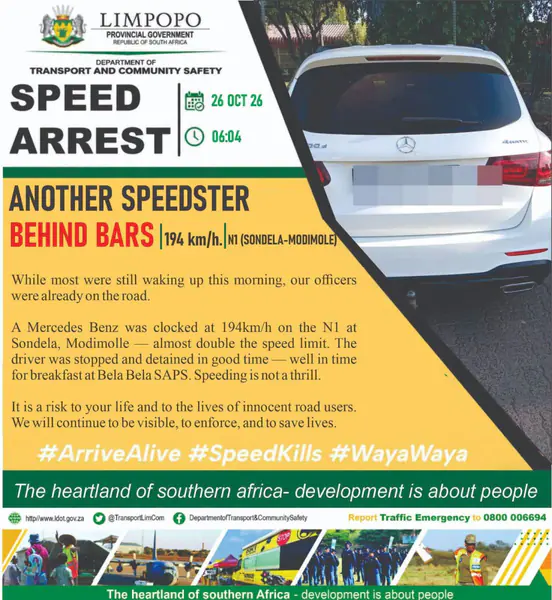
The general speed limits in South Africa are 60 km/h in urban areas, 100 km/h on other public roads and 120 km/h on freeways (regulation 292), unless a sign shows something different. Remember that a speed limit is the most you may drive, not a target. In rain, fog or heavy traffic the safe speed is lower.
A few habits make a big difference. Keep at least a two-second gap to the car in front, and more when the road is wet. Check your mirrors and look over your shoulder before you change lanes. On roads with more than one lane in your direction, keep left and pass right. And the yellow shoulder is not an extra lane: regulation 298A only lets you move onto it on a road with one lane each way, in daylight, while someone is overtaking you and only when it is safe. On a freeway it is never a passing lane. When you hear a siren, slow down, move left when you safely can and let the emergency vehicle through.
None of this is new, but we all get lazy. The guides below are a good refresher, even for drivers who have had their licence for decades.
10 guides
Guides by Arrive Alive
Following Distances and Road Crashes
Read on Arrive AliveSafe Overtaking and Road Safety
Read on Arrive AliveSafe Driving and Sharing and Changing Lanes
Read on Arrive AliveSharing Roads and the Zipper Merge in Traffic
Read on Arrive AliveIntersections and Safe Driving
Read on Arrive AliveThe U-Turn as a Threat to Road Safety
Read on Arrive AliveBlind Spots and Road Safety
Read on Arrive AliveSpeeding, Safe Driving and Road Crashes
Read on Arrive AliveDefensive Driving and Making Roads Safer
Read on Arrive AliveSafe Driving when Hearing the Emergency Siren
Read on Arrive Alive